About OASC knowledge exchange
Knowledge exchange events are aimed at all members of the OASC community. They provide a peer-to-peer learning opportunity by exchanging successful use cases and best practices on various relevant digitisation topics.
The events are moderated online roundtable discussions that bring together practitioners across our entire network to share their experiences on specific digitisation topics. They also offer opportunities to ask questions and obtain advice to help you on your journey.
Whether you are a thought leader and front-runner or just curious about how to put things into practice in your community, the OASC knowledge exchange allows you to share your knowledge with others, obtain feedback or just learn from your peers.
About the event
Our first knowledge exchange will focus on digital twins for cities and communities.
Digital twins are digital representations of real-world assets, infrastructure, systems, and business processes. They are connected to their real-world counterparts and the environment they operate in through IoT devices, sensors, and other data sources.
Digital twins are becoming a promising tool for improving local authority and city decision-making. Using 3D visualisations of their towns and simulations based on real-world data, city planners, policymakers, and decision-makers can explore different actions and possible outcomes. Based on the derived evidence, better solutions can then be implemented. Digital twins also provide excellent communication tools towards citizens, making policy decisions more tangible and easy to understand.
The potential use cases for digital twins in cities are diverse and inspiring. They can range from optimising traffic management and mobility services to reducing energy and resource consumption across cities. By offering insights to improve urban planning, sustainability, and resilience, digital twins can significantly enhance the efficiency and effectiveness of city operations.
Various members of our OASC network have started exploring the benefits of digital twin technologies in their respective communities. As they experimented with initial use cases, these pioneers had to overcome many organisational and technical challenges and overinflated market expectations. The OASC team has also been involved in various local digital twin initiatives and has accumulated valuable learnings.
We are proud to have an exciting panel of digital twin practitioners to set the stage for the roundtable conversation. We will first learn about four different case studies of urban digital twins and explore the benefits they have enabled, the challenges that must be overcome, and the failures and lessons learned along the way. Then, all participants will be invited to contribute to the round table discussion by asking further questions and/or sharing their experiences.
The roundtable will explore the following questions:
- How to get a local digital twin in your community off the ground?
- What digital twin use cases already deliver value?
- What are the key implementation challenges, and how can they be approached?
- What are common pitfalls, and how can they be avoided?
- What are the most promising use cases to work on next?
A draft agenda is presented below:
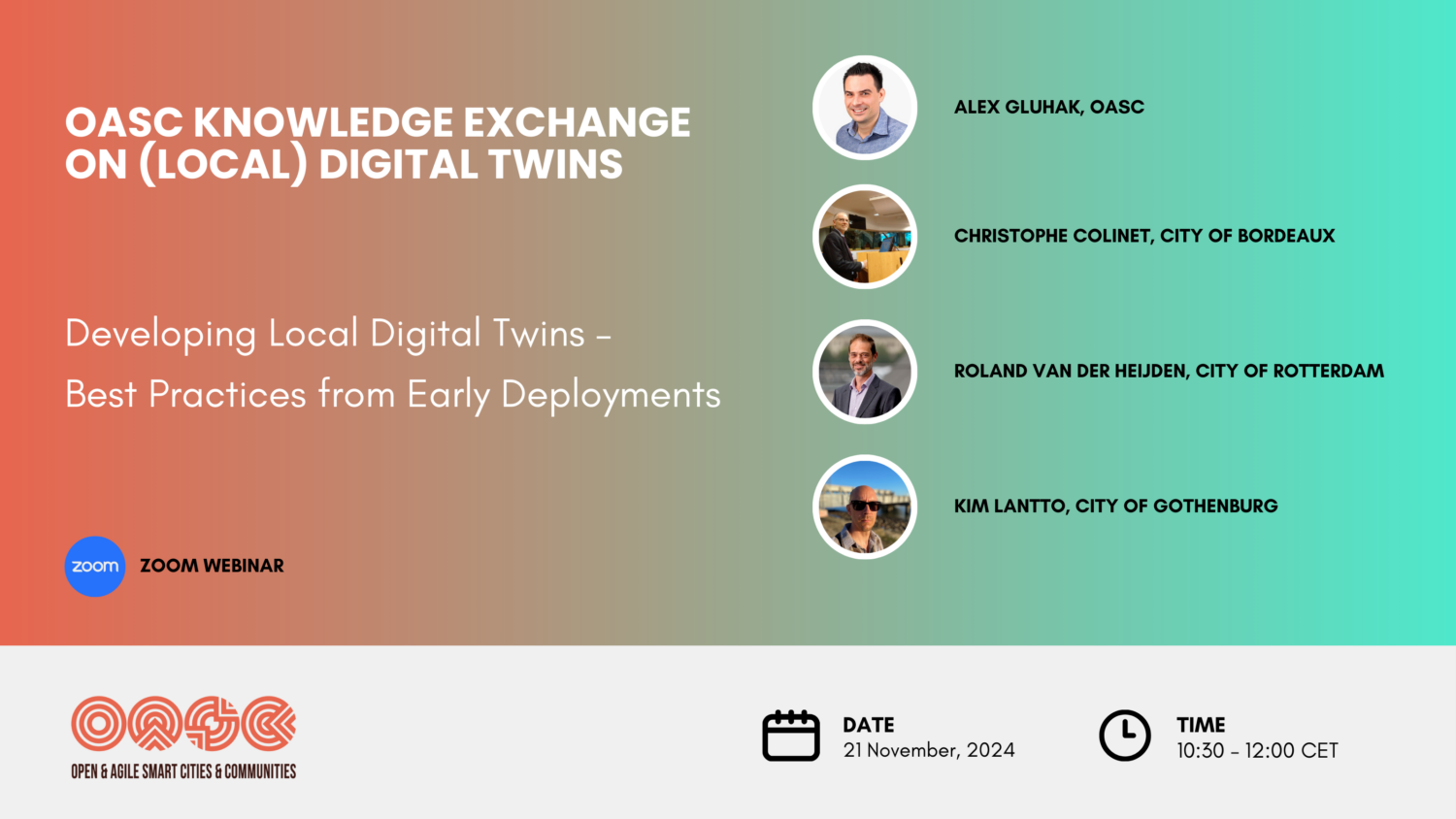
- “Welcome, and introductions to the topic and panel speakers”, Alex Gluhak, OASC – (10mins)
- Digital Twin Case studies
– Case Study 1: Christophe Colinet, City of Bordeaux – (15 mins)
– Case Study 2: Roland van der Heijden, City of Rotterdam – (15 mins)
– Case Study 3: Kim Lantto, City of Gothenburg – (15 mins) - Round table discussion, moderated by Alex Gluhak, OASC – (30 mins)
- Wrap-up – (5 mins)